

Examples Of Harmony In Art
Have you e'er viewed a painting and thought that information technology was almost nigh to perfect, there was only something to information technology that made it feel consummate? This is probably because of the complimenting fine art elements creating harmony. Just what is harmony in art exactly? In this article, we volition delve deeper into finding a harmony in fine art definition, discussing its function every bit i of the principles of art likewise as providing illustrative art and harmony painting examples.
Table of Contents
- 1 What Is Harmony in Art?
- 1.ane The Difference Between Harmony and Unity
- 2 How to Create Harmony in Art
- ii.i Harmony Created past Colour and Value
- 2.2 Harmony Created past Shapes and Forms
- 2.3 Harmony and Texture
- iii Summary of Harmony in Art
- 4 Principles of Art – Further Readings
- 5 Frequently Asked Questions
- 5.i What Is Harmony in Art?
- 5.2 What Is the Difference Between Harmony and Unity in Art?
- 5.3 What Are the Principles of Art?
What Is Harmony in Art?
Harmony is one of the principles of fine art. These are utilized aslope the seven elements of art, which are the tools used to make an artwork, visually and contextually. The main principles of art are balance, emphasis, scale, proportion, movement, rhythm, diverseness, contrast, unity, and harmony.
The elements of art, which are too referred to as the "building blocks" of artwork are color, line, texture, value, space, shape, and form.
Harmony in art is created when these elements are utilized in such a way that they complement or relate to one another, for example, when similar colour schemes are used, or the same shapes or forms are combined.
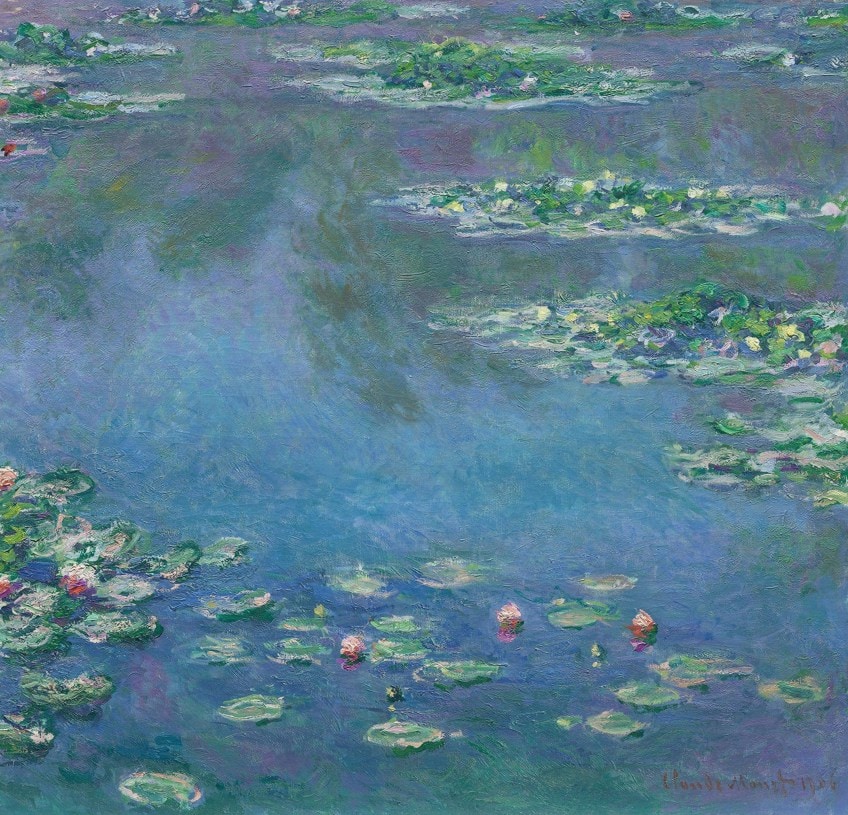 H2o Lilies (1906) by Claude Monet;Claude Monet, Public domain, via Wikimedia Commons
I art element tin can also be applied in a repeated manner among different art elements, which volition still give the artwork a sense of harmony, such equally if the same texture is utilized simply there are dissimilar colors and shapes. We will hash out this further below. When there is a relation of fine art elements the art composition appears visually pleasing, or highly-seasoned, and information technology will be easier on our gaze.
However, it is also important to note the reverse of harmony is multifariousness; when there is likewise much harmony and not enough variety, the artwork will potentially announced monotonous or uneventful.
The Deviation Between Harmony and Unity
Before we move on, it is of import to outline the differences between harmony and unity, equally these 2 principles can be dislocated with each other because they are similar concepts. When it comes to harmony in art, it refers to various art elements arranged in relation to one some other that makes the composition appealing and well-balanced, so to say.
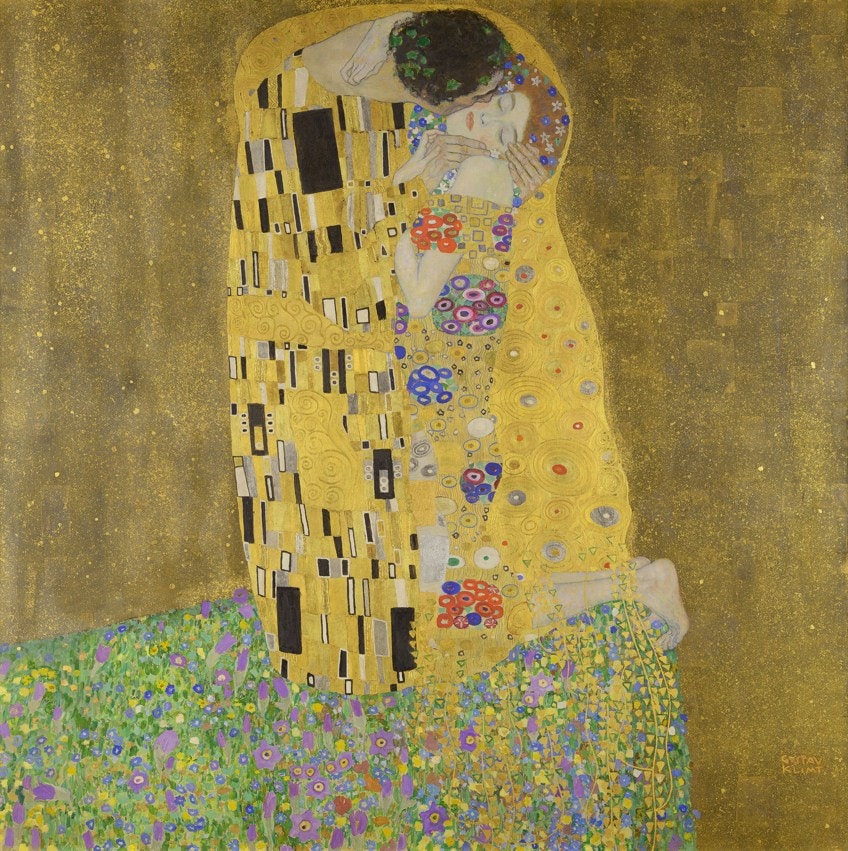 The Kiss (1907-1908) past Gustav Klimt, an example of unity in art;Gustav Klimt, Public domain, via Wikimedia Commons
Unity in art, on the other mitt, refers to the overall holistic quality of an fine art composition, to which harmony will contribute. In fact, most of the principles of art will contribute to the overall unity of artwork, and how they are utilized volition determine the level of unity. Unity is often described in terms of all the parts working "together", giving the artwork "oneness".
There are several techniques or methods that will aid in creating unity in an artwork, namely, proximity, repetition, and simplicity.
How to Create Harmony in Art
Creating harmony in fine art relates to all the elements in fine art working together or in effective relation to one another. Below, we volition outline how important art elements like color, value, shape, course, and texture, tin exist utilized to create harmony in fine art.
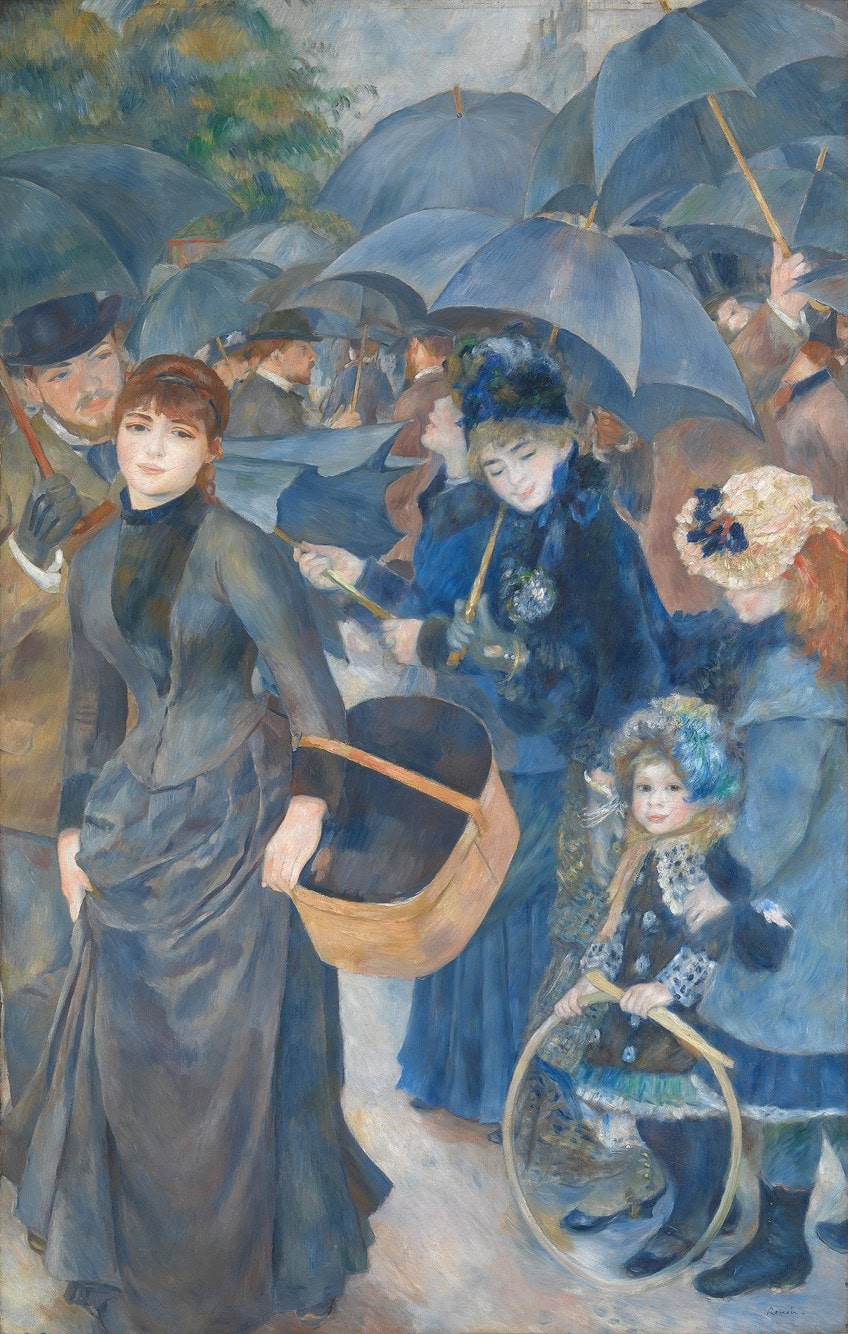 The Umbrellas (c. 1881-1886) by Pierre-Auguste Renoir;Pierre-Auguste Renoir , Public domain, via Wikimedia Commons
Harmony Created by Color and Value
Harmony in colour can be achieved through the minimal use of colors and non too many opposing colors. Utilizing different shades or tones of i colour will create varying effects depending on the meaning of the subject thing; it can either create a sense of calm or be energized and lively, overall creating a unity of the whole.
At that place are also different color schemes to work with.
With the color cycle in heed, these are in unlike groups, namely, monochromatic; complementary, which are colors that occur opposite each other; analogous colors, which are colors next to each other; and triadic colors, which are three colors with even spaces between them.
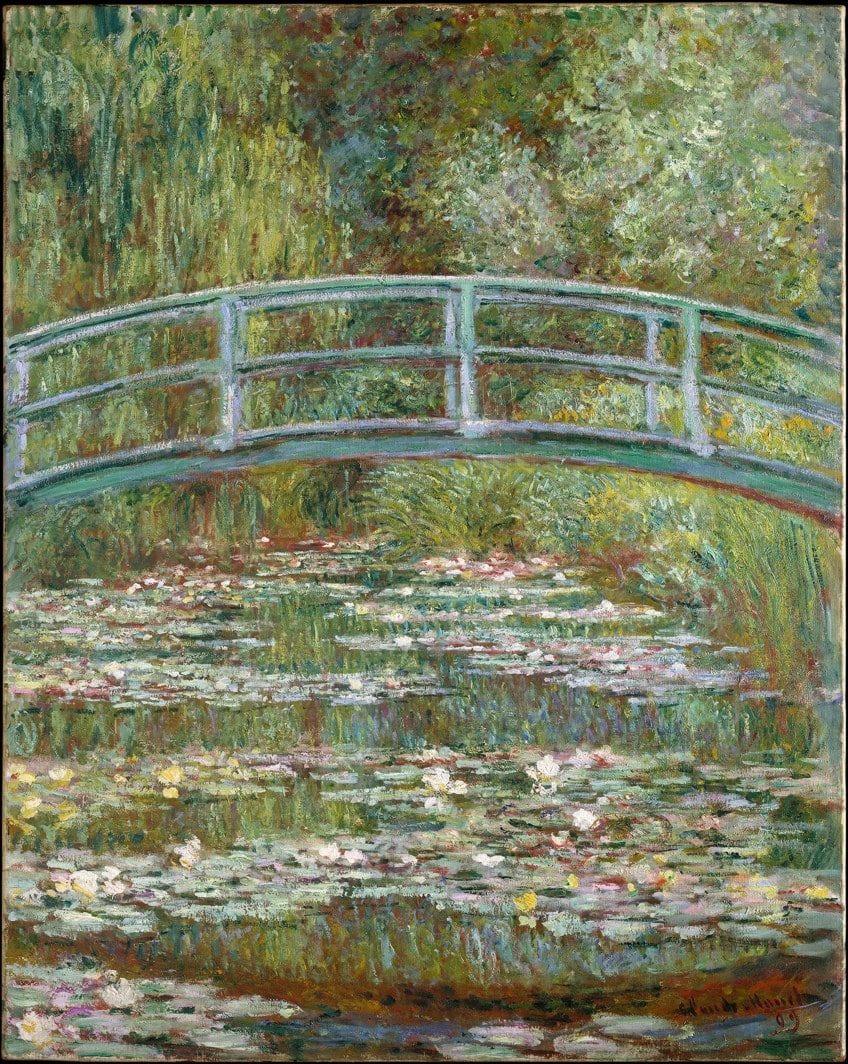 Bridge Over a Pond of Water Lilies (1899) by Claude Monet;Claude Monet, CC0, via Wikimedia Commons
An instance of harmony in art using colour includes Claude Monet's Span Over a Pond of Water Lilies (1899), which depicts a dominance of blues and greens in softened tones, making information technology easy on our gaze. Some other example includes Vincent van Gogh's Quinces, lemons, pears and grapes (1887-1888), which is primarily painted with yellow with red shading here and there.
Harmony is created hither considering of the different tones of yellows, seemingly unifying all the other elements.
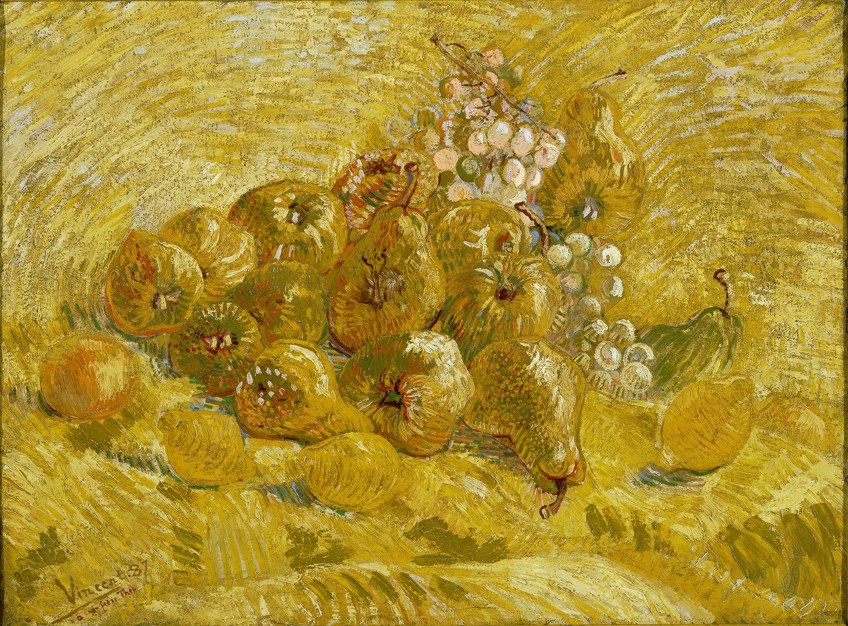 Quinces, lemons, pears and grapes (1887-1888) by Vincent van Gogh;Vincent van Gogh, Public domain, via Wikimedia Commons
Harmony in value can exist closely related to colour, however, value in fine art refers to the lightness and darkness of a colour. This is also ameliorate illustrated when a painting is viewed on a grayscale, which indicates darker or lighter areas.
This is what the value of the color is.
Examples of harmony in fine art using value include, over again, another painting by Claude Monet, titled Charing Cross Bridge (1903). This illustrates what is known equally a "high key" colour value when lighter colour tones are used; a "low fundamental" colour value refers to darker colour tones, for example, Whistler'due south Mother (1871) by James Abbot McNeill Whistler.
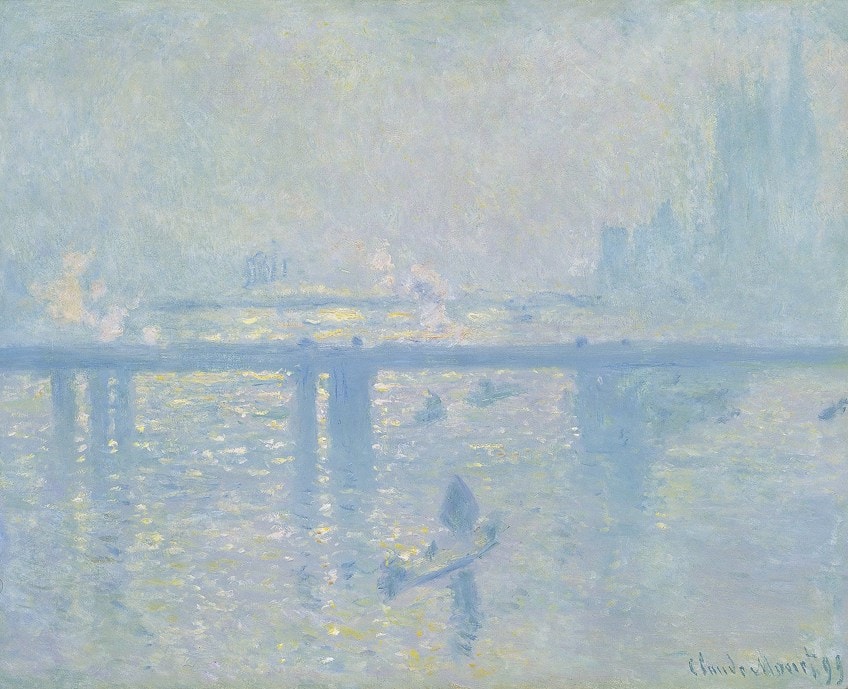 Charing Cross Bridge (1899) by Claude Monet;Claude Monet, Public domain, via Wikimedia Commons
Harmony Created by Shapes and Forms
When similar shapes or forms are utilized in patterns or repetitions information technology creates a sense of consistency throughout the composition, which ultimately creates a sense of harmony. There are dissimilar shapes similar circles, squares, rectangles, or triangles.
Examples of harmony in art using shapes include Paul Cézanne's Mont Sainte-Victoire (1904-1906), which is equanimous of geometric structures illustrating the mural, from the copse in the foreground to the houses in the middle-basis, and the angularity of the mountain in the background.
Although at that place is a strong dominance of shapes in this painting, it does non announced overly monotonous.
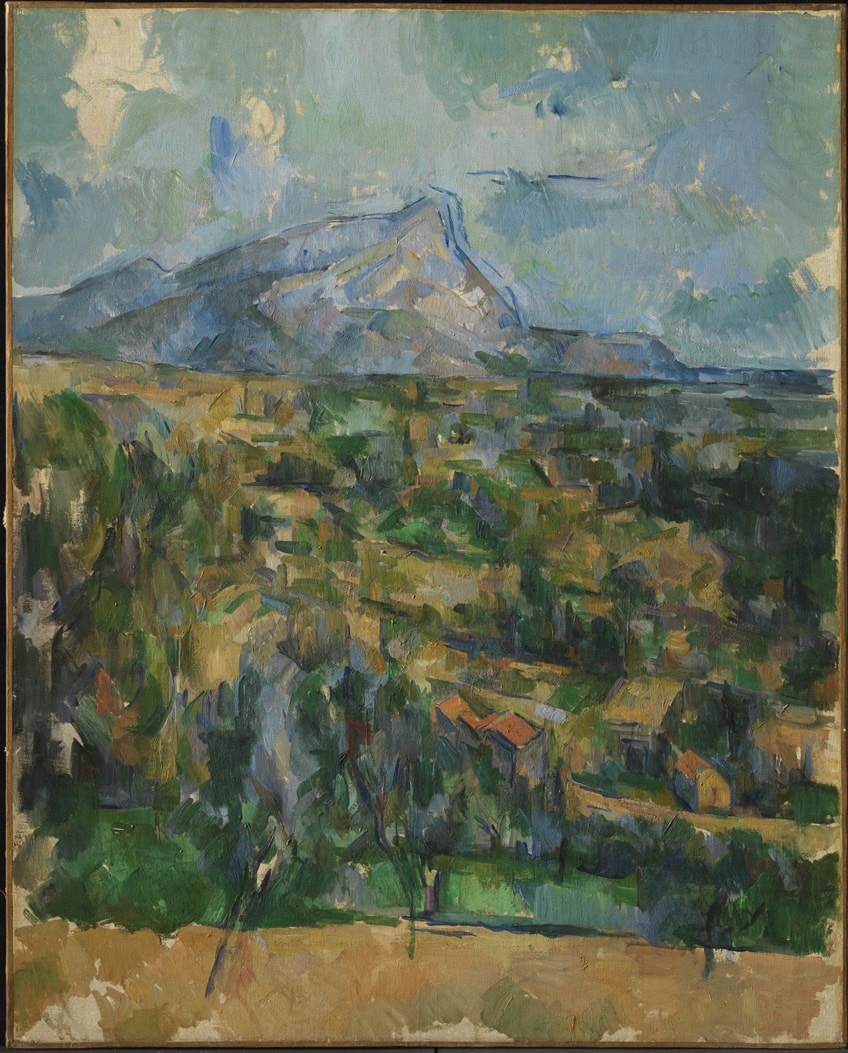 Mont Sainte-Victoire (1904-1906) by Paul Cézanne;Paul Cézanne, Public domain, via Wikimedia Commons
Many abstract artists utilize geometric shapes and forms to convey deeper meanings of life while some but practise information technology for no subjective significant at all. If nosotros await at Piet Mondrian's Composition with grid #1 (1918), it depicts yellow, white, and greyness squares and rectangles separated by thick black outlines.
Although the shapes are unlike in size, they are similar types, coupled with the minimal utilise of colors, giving the composition a congruency throughout.
Harmony and Texture
Texture in art is created by brushstrokes; if at that place is a consistent brushstroke fashion applied in a visual composition information technology can give it a sense of harmony due to the rhythm or flow the strokes follow. These tin be fifty-fifty over the surface of the canvas, such as in watercolors or oil paintings, typically from Academic art where paintings followed strict rules of application, or information technology tin can be more haphazard and thicker, like the impasto technique, which is usually seen in Impressionist paintings.
Famous examples of harmony in art using texture include Vincent van Gogh'southward paintings like Olive Trees Under a Yellow Sky, and the November Dominicus (1889), which has a rhythmic period of brusk, almost choppy, brushstrokes all over making up the discipline matter.
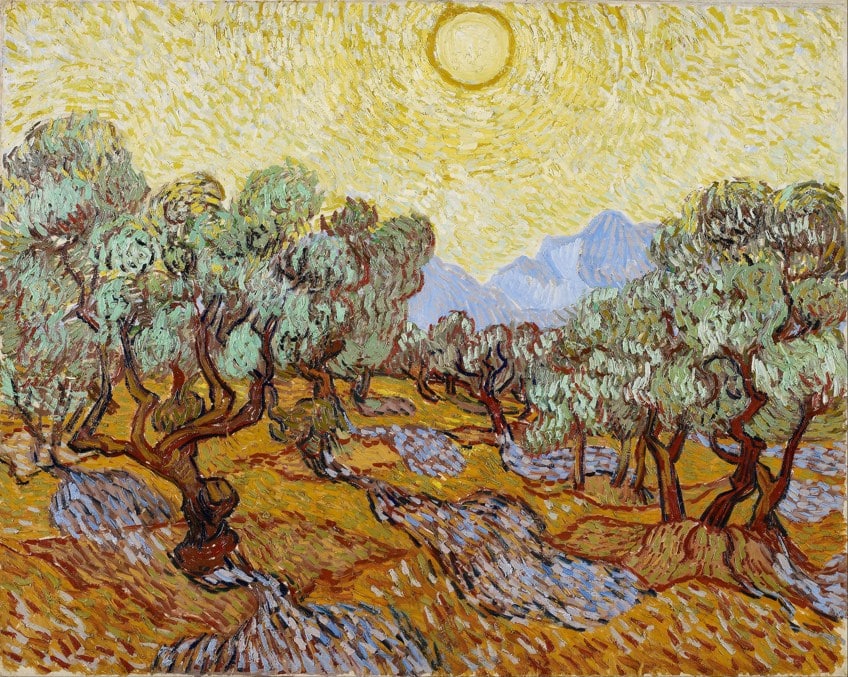 Olive Trees Nether a Yellow Heaven, and the November Sun (1889) by Vincent van Gogh;Vincent van Gogh, Public domain, via Wikimedia Commons
Artists like Georges Seurat used another type of brushstroke referred to as Pointillism, which consisted of dots of pigment. His A Sunday Afternoon on the Island of La Grande Jatte (1884-1886) is a famous example of this style, but also how the use of the same brushstroke style creates harmony fifty-fifty when different colors or shapes are utilized.
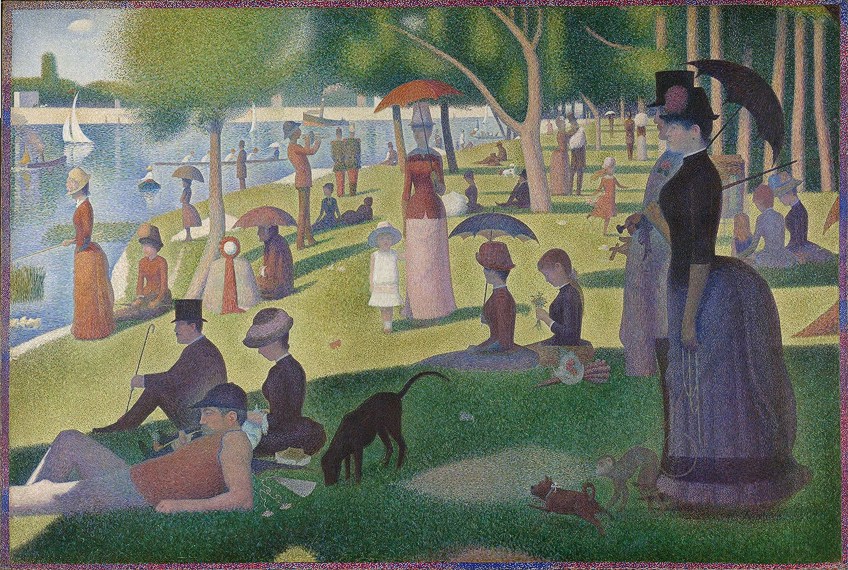 A Sunday Afternoon on the Island of La Grande Jatte (1884-1886) by Georges Seurat; Georges Seurat, Public domain, via Wikimedia Commons
Summary of Harmony in Art
| Harmony in Art | Characteristics | Artwork Examples |
| Color and Value | Using unlike color schemes like monochromatic, complementary, analogous, and triadic colors. Using low-fundamental or high-key colour tones. | Bridge Over a Swimming of Water Lilies (1899) past Claude Monet Quinces, lemons, pears and grapes (1887) past Vincent van Gogh Charing Cantankerous Bridge (1903) by Claude Monet Whistler'south Mother (1871) by James Abbot McNeill Whistler |
| Shapes and Forms | Using similar geometric shapes or forms arranged in patterns or repeated. | Mont Sainte-Victoire (1904-1906) past Paul Cézanne Composition with grid #i (1918) by Piet Mondrian |
| Texture | Using dissimilar types of textures like thick (Impasto) or thin, short, and long brushstrokes, applied evenly or haphazardly on the visual surface. | Olive Trees Under a Yellow Sky, and the Nov Sun (1889) by Vincent van Gogh Sunday Afternoon on the Island of La Grande Jatte (1884) by Georges Seurat |
Principles of Art – Further Readings
- Principles of Art main article
- Movement in Art
- Emphasis in Art
- Unity in Art
- Rhythm in Art
- Texture in Fine art
- Proportion in Art
- Remainder in Art
Towards uncovering the harmony in art definition, this article explored how it can be created through various art elements similar colour, value, shape, form, and texture. Nosotros likewise explored art and harmony painting examples, illustrating the different ways art elements tin exist applied to create a harmonious result. There is no ane-size-fits-all technique when it comes to harmony in art, and it requires a level of exploration to achieve the desired result. Each fine art element brings with it a unique fashion and when this is utilized with the principles of art, we tin compose almost any visual artwork we wish to.
Have a look at our harmony fine art webstory here!
Frequently Asked Questions
What Is Harmony in Fine art?
Harmony in art is when related or similar art elements are combined to create a so-chosen visually appealing artwork. Combined with the principles of art, this can be related to colors arranged in patterns or repetitions, or the same blazon of shapes or lines arranged in a way that creates rhythm, which results in a harmonious issue.
What Is the Deviation Between Harmony and Unity in Art?
Harmony is near applying similar or repeated art elements to create an artwork that appears well-balanced or pleasing in a visual sense. Unity in art refers to the overall or broader idea of the artwork appearing visually pleasing, where all art elements work in unison.
What Are the Principles of Art?
The principles of art include harmony, balance, unity, proportion, scale, rhythm, movement, emphasis, variety, and contrast. These are also referred to every bit design principles and can exist applied in all art modalities like painting, sculpture, graphic arts, or cartoon, among others.

Examples Of Harmony In Art,
Source: https://artincontext.org/harmony-in-art/
Posted by: kangyouce1995.blogspot.com
0 Response to "Examples Of Harmony In Art"
Post a Comment